Sunday School #23: Write every day
Happy snowy Sunday!
2021 is trying hard to be crazier than 2020. More reason to keep sharpening our learning tools to deal with uncertainty.
I've forced myself to not watch the news and instead keep on building. In two weeks, I'll launch Learning Worker Club and there's enough preparation left to do. In the next newsletter, you'll be the first to see what I've started, before launching on Monday.
Apart from building RoamStack and Learning Worker Club, I've kept busy by writing every day. Participating in the Ship 30 for 30 program, I'm pushed to get back to the keyboard every day and publish an atomic essay—a 250 to 300-word piece. Enough to on a mobile phone's screen. So far, so good with 14 pieces shipped and number 15 lined up.
If you're looking to get into a writing groove and want to start with something accessible, I wholeheartedly recommend Ship 30 for 30. The community is super friendly and helpful, and each week we're teamed up with a new writing buddy. The only thing I'd like to see is more focus on feedback. Without pointers on where to improve, deliberate practice becomes difficult. But, this should sort itself out with advanced groups in future cohorts. Next month, I'll switch to writing and publishing one long-form piece to one of my blogs each day.
Click here to join us in February (yes, I'll get a small fee).
As a result of my little ultralearning project, this newsletter edition is different. Apart from writing, I've only read books in the past two weeks—no articles. So, I have nothing to link to! For now, you'll have to do with my ramblings.
Below you'll find the five most popular atomic essays I've written in the past two weeks. Some are better than others, depending on how I felt that day. In my view, I went from good to meh—mostly because I've been trying to cut down on editing time. I'm curious to see how this pans out, and if I can get back to good without doubling my fiddle time.
See this Twitter thread for all my essays and chime in with your thoughts.
Enjoy and I'll speak to you in two weeks!
—Ramses
Why I write every day
Writing is thinking. Without scribbling or typing, I have few coherent thoughts. But when I focus my mind on explaining something using text, a rich mental landscape comes to life.
I've been a writer for as long as I can remember. When I got my first PC at age six, the first program I wanted to use was the text editor. After all, I just learned to write and had stories to tell!
My parents accused me of living in my head. I don't blame them; I like to stare into space while a million ideas pass my consciousness.
I'm not short for words; the only problem is the speed with which I can write down my thoughts—that, and filtering out the textual diarrhea that leaves my fingers.
I have many half-assed ideas that I need to think through. And if writing is thinking, then writing is my best bet to think good ideas forward.
Writing also helps me to learn. Forcing myself to explain things, I soon realize I have no fucking clue what I'm talking about. That's my cue to learn.
The only way to improve my writing is to write consistently, which means every day. Or as learning geeks like to say: by practicing deliberately.
Writing is my way to catch ideas, sharpen my thoughts, and pass on wisdom to my future self.
Until now, I took writing for granted. Not any longer; I'm writing and shipping daily.
Let's learn to write and write to learn.
Write to learn
You can teach yourself. If you're reading this, you have the ultimate teaching and learning tool; writing. By explaining things to yourself, you uncover holes in understanding— enabling you to learn deliberately.
Richard Feynman—the physicist—famously had a quote in the corner of his blackboard; "What I cannot create, I do not understand," followed by "Know how to solve every problem that has been solved."
Feynman took pen to paper and worked from memory, explaining concepts to himself in simple terms. If he couldn't, that was his cue to dig deeper. By seeing simple explanations in his own words, he could make ideas his own and wrap his head around complex topics.
Writing about a topic makes it easier to cement a flash of insight into long-term memory. You'll have a note to teach you, plus you're more likely to remember your own words than someone else's.
When learning theory, ask yourself:
- What are the key ideas?
- What are some examples?
- How do these ideas connect to what I already know
Now you go from passive learning to teaching yourself. Your own words often resonate the most, and you learn more deeply by connecting relevant ideas. There's always someone who needs to hear your voice—you.
Once you start practicing new knowledge or a skill, reflect by asking yourself after every session:
- What went well?
- What could have gone better?
- What do I need to learn to improve?
Plus, minus, next; a simple framework to improve skills.
Don't leave your progress to chance. Slow down, ponder useful ideas, and write out loud before and after turning ideas into action.
Write to learn.
Build a learning infrastructure
Your mind is a sieve. Only a fraction of what travels over your neural pathways sticks; everything else is filtered out.
Forgetting is not a curse. Without forgetting, everything that you ever did or said would haunt you forever. But if you're trying to learn, you want to minimize forgetting in the long term.
Remembering everything is impossible, so we need systems to help us keep the useful bits of knowledge. Our best bet is to externalize a part of our thinking—to build a second brain.
Having a second brain is crucial if you want to be an effective learner. Without digital systems, you'll soon face memory overload—the overwhelm that comes from tracking processes.
Your first brain runs on glucose—your second brain runs on text.
Text levels the playing field. Every device and internet connection handles text. Text is easy to save and search. Plus your source material and own notes will also be on the same level: text.
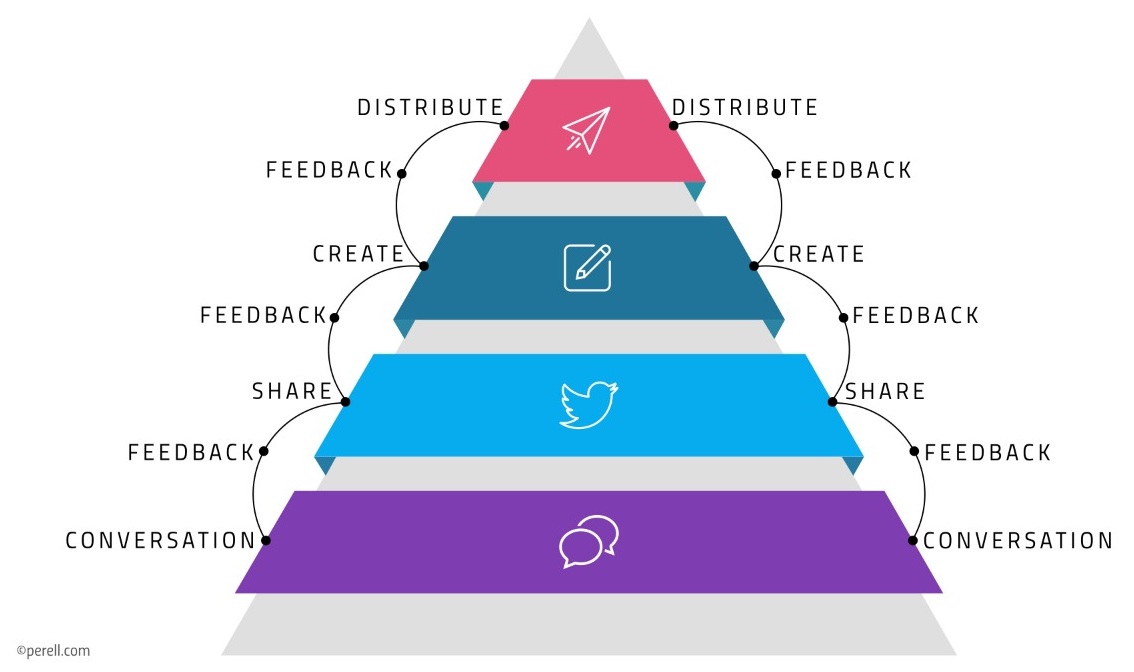
To learn with text, you have to go through three stages: consume, collect, and create. For each phase, your learning infrastructure enables you to focus on the material instead of the process.
Consuming happens when you read a text. Even when you read 'passively,' you're interacting with the author in your mind. Ask: What is unclear or surprising? What other ideas connect to what's presented here?
Collecting starts when you externalize your thoughts. It begins by highlighting whatever resonates with you. Finding out what the author wants to communicate is also a way to find useful highlights. The collection phase is topped off by taking notes on what you've highlighted.
Creating is in everything you do. By collecting highlights and notes, you're creating resources for your future self. Using the ingredients you've distilled in the collection phase, you can create something new that others will consume, collect, and create with.
This is the cycle from information to insight—one that never ends.
If you want to thrive in this Information Age, you need to build your learning infrastructure. Start now.
Learning is messy
Life is messy. Our brains evolved in a chaotic world, not in a classroom. While we're now spoon-fed knowledge, our ancestors couldn't predict what they needed to learn—they knew when death was staring them in the face.
School gives the illusion you can divide knowledge into sequential units. But, only when you put things into practice do you know what you need to know. The solution? Start before you're ready.
Not knowing where you're going is part of the learning process. When getting stuck, you often discover there's something else you need to understand first. Only by accepting side quests can you move closer to mastery.
You can't plan for detours—you'll know when to take one. Learning is like crossing a river using stepping stones; you can plan all you like, but once underway, your vision narrows and you have to reorient after every step.
Messy learning fulfills two effective learning principles: interleaving and spacing. Research shows that mixing up topics and spacing practice makes for stronger learning. So, relax and follow your curiosity—it's often a useful guide.
Finally, always make sure that what you're learning is useful. Instead of practicing the same subskill over and over, it's better to build something real multiple times. That way, you mix up practice and space it out in time.
Don't worry if learning projects don't go as planned. Ask yourself: have I learned something useful?
As long as you make progress, all is good.
Don't learn language—acquire them
Do you learn languages, or do you acquire them?
Most people acquire their native language but learn foreign languages. Brainwashed by school, adults ditch the natural approach for artificial materials that never lead to fluency. Be different if you want to become fluent.
Throw away your apps, books, and courses. All you need is a lot of exposure to your target language. Immerse yourself and rewire your brain. Let the language become part of you.
Follow these five principles to acquire any language:
Fun first. To acquire a language, you need to show up every day. You'll only find the motivation and energy to return to your target language if you enjoy the journey. Make fun the all-deciding factor when choosing materials.
Input over output. What doesn't go in can't come out. Focus on getting a lot of input first. Invest your time in reading and listening to your target language—output can wait. The more input you get, the better your output will be.
Use native content. Skip the unnatural language from textbooks and other materials aimed at learners. Massive input is only fun when you use real content. Listen and read like the natives—immerse yourself in the culture.
Practice with flashcards. What you can't understand won't be fun for long. Build your comprehension by using flashcards. Only add full sentences, put your target language on the front, and the language will grow in you.
Don't study grammar rules. Memorizing grammar rules never leads to fluency. Spontaneous output is only possible if the language becomes part of your subconscious. Review grammar once you've started to write in your target language. Your intuition for grammar grows through input.
Apply these principles daily, and you'll become fluent.
That last piece was controversial. Strange, that always happens when I write about learning learning acquisition. Suddenly, everyone's an expert.
Want to stay up to date with my writing antics? Bookmark this thread or follow me on Twitter.
Sunday School
Happy New Year! 🎉 How has 2020 been to you? Even if it's been a shitshow like it has been for many, we have to realize everything has its bright side. For me, 2020 was when I decided to leave the corporate rat race and start teaching online. Since September, I've taught dozens of hours online and been building a community in the meanwhile. That has been possible because I started this newsletter in May, wanting to talk about how to become better at learning. While I left university almost ten...

Happy Sunday from rainy Amsterdam! And a special welcome to all 51 new subscribers who will test out the reading guides I'm creating for the books Make It Stick, Ultralearning, and How to Take Smart Notes (see the end of this newsletter if you don't know the project). Today's Sunday School is all about deliberate practice, a way of intentionally practicing that maximizes learning. While challenging to do, it's a crucial tactic to reach expert-level performance in a field. Deliberate practice...
Happy Sunday! Being a knowledge worker with ADHD, it can be extremely difficult to find the clarity and focus to see things through to the end. My mind jumps from topic to topic, getting triggered by what I’m trying to focus on. On the flip side, when I do find focus, it tends to be hyperfocus. It’s not uncommon for me to sit 12 hours straight, working on a project, forgetting everything and everyone around me, even ignoring bodily functions like thirst and hunger. By exploring different...