Sunday School #20: Find clarity and focus
Happy Sunday!
Being a knowledge worker with ADHD, it can be extremely difficult to find the clarity and focus to see things through to the end. My mind jumps from topic to topic, getting triggered by what I’m trying to focus on.
On the flip side, when I do find focus, it tends to be hyperfocus. It’s not uncommon for me to sit 12 hours straight, working on a project, forgetting everything and everyone around me, even ignoring bodily functions like thirst and hunger.
By exploring different systems for thinking and behaving, I’ve progressively found ways that help me find clarity and keep focus while still taking care of myself.
This edition is all about finding clarity and focus in a distracted world. I start by linking to my newest blog article about intermediate packets before looking at how externalizing our thoughts and shipping often can help us do meaningful work.
In this newsletter:
- How intermediate packets made me a learning worker.
- How building a second brain helps you get into flow.
- How to treat your content as a Minimum Viable Product.
- Self-care using the Wim Hof Method.
-
Twitter 🧵:
- Going from raw notes to evergreen notes.
- My 10-step writing process with Roam Research.
New on Ramses.blog
🧱 Become a learning worker by creating intermediate packets
In the past week, I’ve been chipping away at this 2,500-word piece about intermediate packets. As they are central in enabling me to be a learning worker, I wanted to dive into how they helped me narrow the scope of my work and provide value more often.
Through my seven reasons for using intermediate packets, you’ll hopefully find inspiration to apply this technique to your own knowledge work:
- Intermediate packets help me provide value more often.
- Intermediate packets make me interruption proof.
- Intermediate packets help me create regardless of circumstances.
- Intermediate packets keep me motivated.
- Intermediate packets help my future self.
- Intermediate packets get me more and better feedback.
- Intermediate packets make heavy lifts a thing of the past.
Learning from the web
🧠 How Building a Second Brain Triggers Flow and Enhances Wellbeing (Glen Lubbert)
Glen is a fellow mentor from cohort 11 of Building a Second Brain. An important part of his lessons is about achieving a flow state by externalizing thoughts and integrating body and mind through exercises.
In this article, Glen outlines the four phases of flow and how to best deal with each of them:
- Struggle—the unpleasant phase as you’re getting into the work. It’s key to maximize clarity of goals and to minimize distractions at this point.
- Release—use idleness to take your mind off the problem and let the subconscious do its job.
- Flow—the phase where the inner critic shuts up, and you work effortlessly.
- Recovery—winding down and resting up is necessary as the flow state uses many neurochemicals that need to be replenished.
Read the article to get a deeper understanding of what’s involved in getting into a flow state and see Glen’s exact schedule for inspiration.
📈 Minimum Viable Creativity (Ryan Mulholland)
Consistently writing this newsletter has been a struggle. Not because I have nothing to say, but because I’m afraid to show what I created.
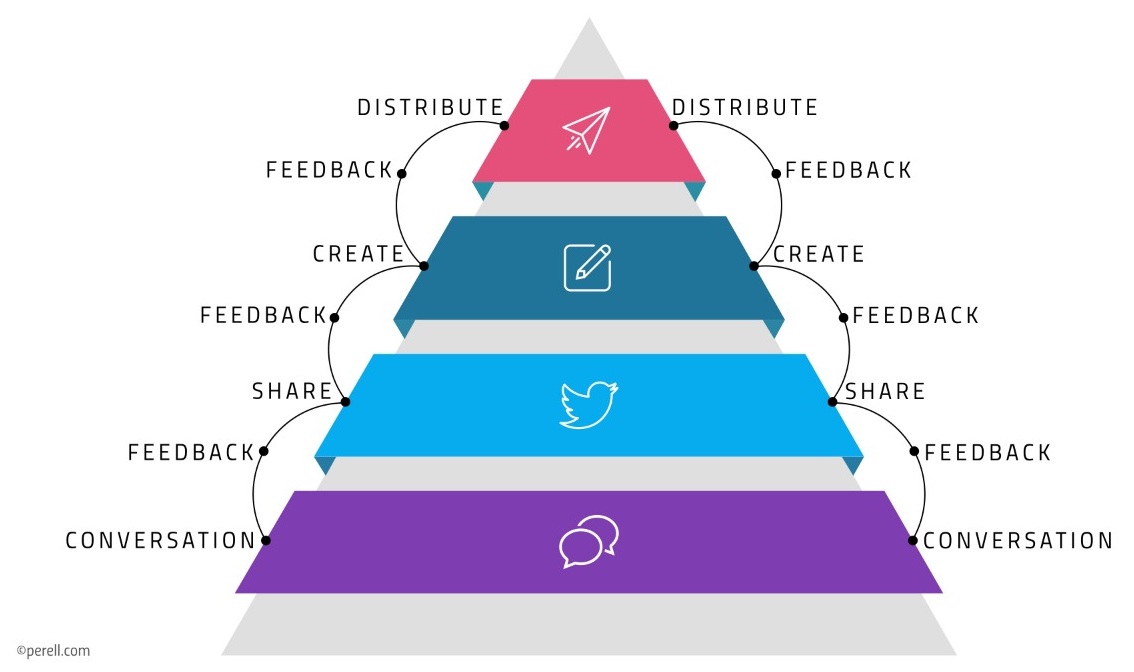
This article by Ryan Mulholland is a useful read for anyone who suffers from a harsh inner critic and could use a perspective shift. Ryan makes a case for creating content like startups develop products. By shipping more often, we gather more and better feedback and focus on ideas that resonate with others.
Instead of seeing content as one big deliverable, you can test the intermediate steps by publishing early and often. This is completely in line with David Perell’s idea of the Content Triangle:
 |
📺 The Mikhaila Peterson Podcast #36 - Wim Hof with Jordan Peterson

I’ve been practicing the Wim Hof Method on and off for close to five years. In that time, I’ve lost 45 KG of fat, got rid of pre-diabetes, and slowly lessened several skin issues I’ve been battling for years.
Coincidentally, this morning an interview with two of my favorite people (Jordan Peterson and Wim Hof) was published by Mikhaila Peterson. I had to watch it right away and thought it would be a perfect mention in the newsletter.
Wim guides Jordan and Mikhaila through a breathing exercise, starting at minute 20. I recommend you follow along and then try out a cycle of 4 x 30 deep breaths, as Wim suggests. While not comfortable, this exercise has helped me tremendously over the years.
The Wim Hof Method is an example of the principle I’d like to call ‘Seeking voluntary discomfort,’ meaning stressing your body to the point that it adapts and becomes stronger.
In practice, this is what I do every day:
- Fast at least 20 hours (I’ve been doing this consistently for the last two years).
- Take a cold shower (I’ve been taking cold showers only in the last five years).
- Deep breathing exercises as Wim Hof recommends.
It's difficult to describe what this practice has done for me. The real proof of my transformation came late last year (exactly one year ago today), when I was rushed to the hospital with acute appendicitis, resulting in a burst appendix. Purely through controlled breathing and controlling my mind could I handle the pain (I didn’t need nor take pain medication). This stuff works.
From my Twitter
📝 Notes from week 2 of Ness Labs’ Collector to Creator course
I’m still focused on doing Anne-Laure Le Cunff’s excellent Collector to Creator course. In week 2, we learned how to turn raw notes into evergreen notes.
Even though I’ve been getting better at creating permanent notes in the past year, I still had lots of takeaways from the lecture and workshop. I’ve compiled my notes into the Twitter thread below, but you can see my full notes here.
♼ My writing process with Roam
Getting back into a publishing habit, I’ve been formalizing my writing process in the last few months.
In this Twitter thread, I explain my 10-step writing process using Roam.
Closing words
That's it for this edition! As always, if you want to share your thoughts or recommended resources, reply to this email or send me a tweet.
Speak to you in two weeks!
—Ramses
Sunday School
Happy snowy Sunday! 2021 is trying hard to be crazier than 2020. More reason to keep sharpening our learning tools to deal with uncertainty. I've forced myself to not watch the news and instead keep on building. In two weeks, I'll launch Learning Worker Club and there's enough preparation left to do. In the next newsletter, you'll be the first to see what I've started, before launching on Monday. Apart from building RoamStack and Learning Worker Club, I've kept busy by writing every day....
Happy New Year! 🎉 How has 2020 been to you? Even if it's been a shitshow like it has been for many, we have to realize everything has its bright side. For me, 2020 was when I decided to leave the corporate rat race and start teaching online. Since September, I've taught dozens of hours online and been building a community in the meanwhile. That has been possible because I started this newsletter in May, wanting to talk about how to become better at learning. While I left university almost ten...
Happy Sunday from rainy Amsterdam! And a special welcome to all 51 new subscribers who will test out the reading guides I'm creating for the books Make It Stick, Ultralearning, and How to Take Smart Notes (see the end of this newsletter if you don't know the project). Today's Sunday School is all about deliberate practice, a way of intentionally practicing that maximizes learning. While challenging to do, it's a crucial tactic to reach expert-level performance in a field. Deliberate practice...