Sunday School #21: Deliberate practice
Happy Sunday from rainy Amsterdam!
And a special welcome to all 51 new subscribers who will test out the reading guides I'm creating for the books Make It Stick, Ultralearning, and How to Take Smart Notes (see the end of this newsletter if you don't know the project).
Today's Sunday School is all about deliberate practice, a way of intentionally practicing that maximizes learning. While challenging to do, it's a crucial tactic to reach expert-level performance in a field.
Deliberate practice is something I've done for years without realizing it. Having ADHD, deliberate practice tends to happen when I become obsessed with small details and enter hyperfocus. Since recently, I've started to plan these practice sessions and look for teachers who can provide me with feedback.
No matter if it's foreign languages or data analysis, deliberate practice helped me gain expert levels quickly. The challenge lies in finding a path (or a teacher) that leads most straight toward a high level. One of the tactics I use is to become better at learning in general, so I have more tools to my disposal when I want to tackle new skills.
In this edition, I link to a few resources that will help you understand the principle of deliberate practice and what to do when a clear path isn't available. I haven't written a post based on the resources, as I'm writing a long, 100-tweet thread about what it means to be a professional learner. Still, I think you'll find more than enough to ponder on if you decide to dig into all resources.
In this newsletter:
- An introduction to deliberate practice;
- An introduction to Eric Anderson's Peak;
- An interview with Anders Ericsson (first researcher to describe deliberate practice);
- Why deliberate practice isn't a flow state;
- Potential problems with deliberate practice.
Learning from the web
🔰 The Beginner’s Guide to Deliberate Practice (James Clear)
If the deliberate practice concept is entirely new for you, I suggest you start with this short article by James Clear. In it, he gives an exact definition of this type of practice and several examples of masters in the world of cooking, martial arts, chess, music, and basketball, and how they practice deliberately.
📺 PNTV: Peak by Anders Ericsson (Brian Johnson)
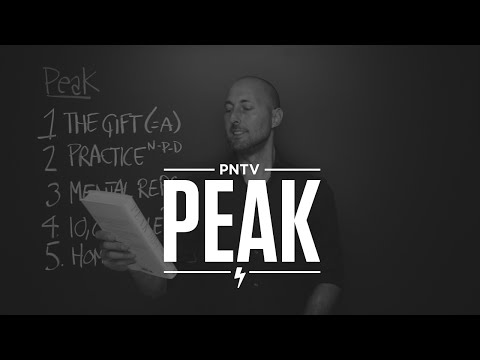
One of my favorite ways to start wrestling with ideas from a book is by watching Brian Johnson's video on it. For many non-fiction books, Brian takes the key lessons and distills them in a 20-minute "philosopher's note."
In this video about the popular science book Peak by Anders Ericsson, Brian distills the following ideas:
- Expert performance rarely has anything to do with people's talent; everyone has the necessary adaptability.
- 'Naive practice' is not as effective as purposeful practice, which in turn is not as effective deliberate practice.
- To become an expert, you need to change your mental representations.
- 10,000 hours of practice is not a rule; sometimes less is needed for expert performance, sometimes much more.
- As humans, we can consciously improve ourselves; thus, we should see ourselves as 'homo exercens,' the type of human who improves through practice.
📈 Flow Doesn't Lead to Mastery (Scott Young)
Flow and deliberate practice are often mentioned in the same breath, but they are completely different concepts. In this piece, learning expert Scott Young has a look at the main differences, and why deliberate practice doesn't (and maybe shouldn't) have to be fun to be effective.
This distinction between flow (fun activities) and deliberate practice (effective activities) is crucial in learning. If you don't make this distinction, you're more likely to pick materials that are fun. While this could lead to purposeful practice eventually, it's hit-and-miss and doesn't guarantee mastery. Picking the effective practice activities that push you out of your comfort zone will be a better way to spend your time.
Scott captured it well in this visual:
📺 Skill Mastery & Peak Performance via Deliberate Practice with Psychologist Anders Ericsson (August Bradley)

The brilliant Anders Ericsson passed away in June of this year, and August Bradley did one of the last interviews with him.
In this hour-long conversation, August and Anders dive into topics like:
- The misconceptions around the 10,000 'rule';
- The difference between purposeful and deliberate practice;
- The role of teachers and coaches;
- Mental representations;
- Moving out of your comfort level;
- Cultivating a passion for skills versus relying on willpower;
- The role that sleep plays in peak performance.
I took way too many notes to summarize in this newsletter, so head over to my public Roam database for my full notes.
⚠️ The Problems with Deliberate Practice (Cedric Chin)
As often, I turn to Cedric Chin to provide some well-needed nuance. This article looks at two claims in the deliberate practice model that simplify it too much: 1) talent is overrated; everyone can reach expert level in any skill, and 2) deliberate practice is better than normal practice.
First, it looks like that in popular scientific circles around deliberate practice, the role of talent is overlooked. But obviously, it's not likely that someone who is 160 cm tall (5' 2") will become an elite basketball player, no matter the amount of practice.
That first claim isn't so relevant for people who need skills for their job. For them, the claim that normal practice isn't as valuable as deliberate practice is relevant. After all, they're after what's useful. It's also problematic, as many fields don't have well-defined paths to mastery.
In the article, Cedric nuances that deliberate practice may not always be possible, and therefore not the best option. But there's a middle way between normal and deliberate practice: purposeful practice. One way to get there is to identify sub-skills for which there are proven training methods, something Cedric points at in the article.
I recommend you read the whole piece and click through to the linked sources. Especially the resources outside of popular science contain a nuanced approach to deliberate practice and point out some potential traps.
From my Twitter
I like to distill ideas to their smallest form possible, and one of the ways I practice this deliberately is by turning my notes into Twitter threads.
In this thread, I've distilled the key takeaways from my notes on the conversation between August Bradly and the late Anders Ericsson. If you're interested in watching the entire conversation, I recommend you first read my thread, then my notes, and then watch the conversation in its entirety.
Speaking of my notes: I've been working on reading guides for the books Make It Stick, Ultralearning, and How to Take Smart Notes. With over 100 people showing interest in testing out the guides and providing feedback, the response has been overwhelming.
Learning from my mistakes, I immediately scaled and created a Google Form to capture the email addresses and some additional insights from those interested.
If you want to read any of these books in January and give me your feedback, fill in this short form so I can send the guides to you once they're ready.
Closing words
That's it for this year! You will receive the next Sunday School on the 3rd of January.
In that edition, I will also have an exciting announcement about a project I've been working on. I can already tell that it's all about making the transition to become a professional learner, so make sure to read it if you're interested in that.
If you have any thoughts to share or questions to ask, don't hesitate to reply to this email or sling a tweet my way.
—Ramses
Sunday School
Happy snowy Sunday! 2021 is trying hard to be crazier than 2020. More reason to keep sharpening our learning tools to deal with uncertainty. I've forced myself to not watch the news and instead keep on building. In two weeks, I'll launch Learning Worker Club and there's enough preparation left to do. In the next newsletter, you'll be the first to see what I've started, before launching on Monday. Apart from building RoamStack and Learning Worker Club, I've kept busy by writing every day....
Happy New Year! 🎉 How has 2020 been to you? Even if it's been a shitshow like it has been for many, we have to realize everything has its bright side. For me, 2020 was when I decided to leave the corporate rat race and start teaching online. Since September, I've taught dozens of hours online and been building a community in the meanwhile. That has been possible because I started this newsletter in May, wanting to talk about how to become better at learning. While I left university almost ten...
Happy Sunday! Being a knowledge worker with ADHD, it can be extremely difficult to find the clarity and focus to see things through to the end. My mind jumps from topic to topic, getting triggered by what I’m trying to focus on. On the flip side, when I do find focus, it tends to be hyperfocus. It’s not uncommon for me to sit 12 hours straight, working on a project, forgetting everything and everyone around me, even ignoring bodily functions like thirst and hunger. By exploring different...